
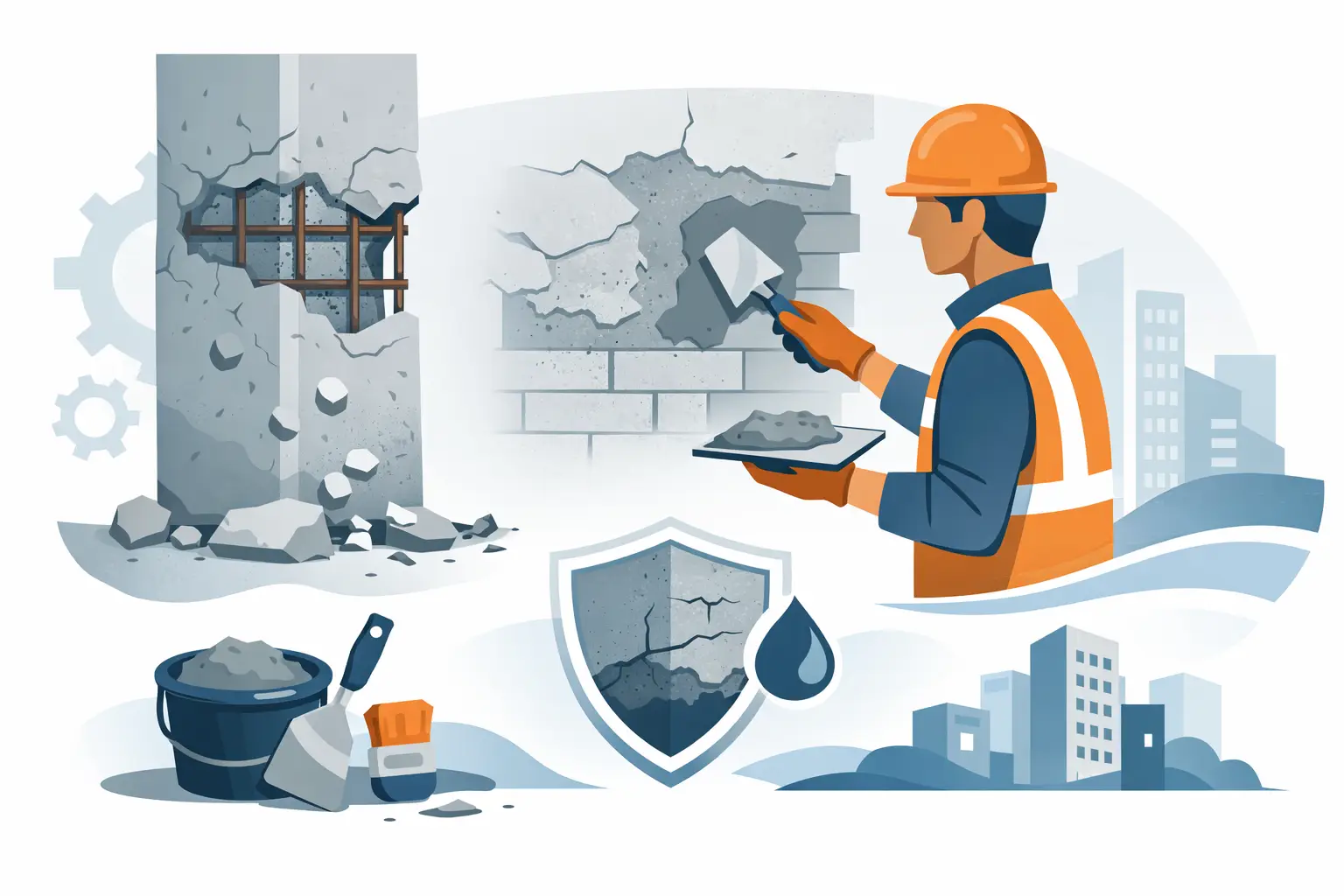
A small crack in concrete rarely stays small for long. What starts as a rough patch on a ceiling edge or a chipped section near a beam can quickly turn into loose concrete, exposed steel, water entry, and a bigger repair bill. That is why property owners often ask about the best solutions for concrete spalling before minor damage turns into a safety issue.
What concrete spalling really means
Concrete spalling happens when the surface layer of concrete breaks, flakes, or pops off. In many cases, the root problem is inside the slab, wall, column, or ceiling. Moisture reaches the reinforcing steel, the steel begins to corrode, and rust expands. That internal pressure pushes the surrounding concrete outward until it cracks and detaches.
In homes, this often shows up on ceilings, balconies, bathroom areas, façade edges, and older exterior walls. In commercial buildings, it can appear in common corridors, parking areas, service zones, and structural members exposed to weather or repeated moisture. The visible damage may look localized, but the underlying deterioration can extend beyond the area that has already broken off.
This is why painting over it is not a solution. Fresh paint may hide the defect for a short time, but it will not stop corrosion, remove unsound concrete, or restore the surface properly.
Best solutions for concrete spalling depend on the cause
The best repair is not always the fastest one. A lasting fix depends on what caused the spalling, how deep the damage goes, and whether the affected area is structural or mostly surface-level.
If the issue comes from water intrusion, the repair should address both the damaged concrete and the source of moisture. If corrosion is advanced, patching alone may not be enough without proper steel treatment. If the area is large or recurring, a broader restoration approach may be more cost-effective than repeating small repairs every few months.
That is why a proper site inspection matters first. Surface damage can look similar from one property to another, but the repair method should match the actual condition.
1. Break out the loose concrete completely
The first step in a proper spalling repair is removing all loose, hollow, or weakened concrete. This sounds straightforward, but it is where many short-lived repairs fail. If damaged concrete is left behind, the new patch will bond to an unstable base and may debond early.
A careful contractor will chip back the affected area until sound concrete is reached. The repair zone may become larger than the original visible defect, but that is usually a good sign. It means the repair is addressing the full damaged section instead of only the part that already fell away.
2. Clean and treat exposed reinforcement
If steel bars are exposed, they need attention before any patching starts. Rust should be removed, and the steel should be treated with an appropriate anti-corrosion or protective coating where needed. This step is critical because untreated reinforcement can keep corroding under the new repair material.
In some cases, the steel has lost enough section that additional assessment is needed. For deeper or more serious deterioration, the right solution may involve more than a standard patch repair. This is where professional judgment matters, especially in structural locations.
3. Use the right repair mortar
Not all patching compounds perform the same way. For concrete spalling, the repair material should be suitable for the substrate, repair depth, and exposure conditions. A quality polymer-modified repair mortar is often used because it offers strong adhesion, good workability, and durability.
The goal is not just to fill the hole. The patch needs to bond well, cure properly, and handle thermal movement and service conditions without cracking or separating. Cheap fillers may lower the immediate cost, but they often lead to rework, which costs more in the long run.
4. Restore the surface properly
After the structural repair is complete, the surface should be leveled, smoothed, and prepared for finishing. This is especially important in homes, offices, and retail spaces where appearance matters as much as safety.
A well-executed spalling repair should not leave an obvious rough patch that disrupts the finish of the wall or ceiling. Surface preparation, plastering where required, and repainting with a suitable coating help restore a clean, polished look.
The role of waterproofing and moisture control
One of the most overlooked parts of the best solutions for concrete spalling is stopping water from getting back in. If moisture was the trigger, concrete repair without moisture control is only half a job.
For exterior walls, balconies, and roof-adjacent areas, hairline cracks, failed sealant joints, and worn protective coatings can allow water to penetrate. In wet interior areas, plumbing leaks or persistent condensation may contribute to the damage. A dependable repair plan should identify these conditions and correct them.
This is where a service provider with both repair and surface finishing experience adds value. The problem is rarely just the broken concrete. It is the whole chain of failure – moisture entry, corrosion, loss of bond, surface breakdown, and then cosmetic deterioration.
When localized repair is enough
Localized repair works well when the spalling is limited, the surrounding concrete remains sound, and the source of damage can be controlled. This is common in early-stage defects on ceilings, beam corners, or isolated wall sections.
In these cases, targeted concrete hacking, steel treatment, patching, and repainting can restore the area effectively without major disruption. For homeowners and property managers, this is often the most practical option because it balances cost, speed, and long-term value.
The key is catching the issue early. A repair that feels small today can become much more invasive once corrosion spreads and more concrete starts to detach.
When wider restoration makes more sense
If multiple areas are spalling, or if the same area has failed before, a patch-by-patch approach may not be the best value. Repeated spot repairs can add up quickly, especially when access, protection, cleanup, and repainting are needed each time.
A broader restoration approach may include sounding and inspection across a larger surface, removing all weak zones, repairing multiple defects together, and applying a protective coating system afterward. For commercial spaces, apartment blocks, and older properties, this can reduce repeat maintenance and improve overall appearance at the same time.
It also helps with planning. Rather than reacting to each new defect as it appears, property owners can resolve the issue more comprehensively and with less disruption over time.
Why DIY spalling repair is risky
Concrete spalling often looks like a simple patching job, but it is easy to underestimate. If you miss hidden delamination, fail to treat the steel, or apply the wrong material on a dusty or damp substrate, the repair may fail much sooner than expected.
There is also the safety aspect. Loose concrete overhead, damaged edges, and repair work near occupied spaces need controlled handling. Dust protection, surface prep, curing, and finishing all affect the result.
For most homeowners and commercial operators, the better route is to have the area inspected and repaired professionally. It saves time, reduces mess, and gives you more confidence that the issue has been solved properly rather than covered up.
What to expect from a professional repair process
A reliable contractor should start with an assessment of the affected area and likely causes. From there, the work usually includes protection of nearby surfaces, removal of unsound concrete, treatment of exposed reinforcement, application of repair mortar, surface refinishing, and repainting where needed.
Just as important is cleanup and coordination. In occupied homes and business spaces, disruption matters. A professional team should manage dust, protect furniture or fixtures where relevant, and keep the work area organized throughout the job.
This is one reason many property owners prefer a complete service partner instead of juggling separate repair, plastering, and painting vendors. Companies such as My Paint Job are positioned for this kind of practical, end-to-end execution, especially when the final finish matters as much as the repair itself.
How to choose the best solution for your property
The best choice comes down to four questions: how severe is the damage, what caused it, how visible is the area, and how long do you want the repair to last? A low-cost patch may seem attractive, but if the cause is still active or the workmanship is rushed, the savings disappear fast.
For a visible ceiling in a living room, a neat and durable finish may be the top priority. For a commercial site, speed and low disruption may matter just as much as aesthetics. For exterior areas, moisture resistance becomes more important. Good repairs are never one-size-fits-all.
If you notice cracking, bulging, rust stains, or flaking concrete, do not wait for pieces to fall. The best solutions for concrete spalling start with early action, proper repair methods, and a finish that protects the surface as well as improves how the space looks. A timely repair does more than fix damage – it helps keep your property safe, presentable, and easier to maintain.


Pingback: How to Treat Wall Stains Before Repainting - My Paint Job Singapore
Pingback: How to Refresh a Rental Apartment Without Risk - My Paint Job Singapore
Pingback: Plastering Versus Skim Coating Walls: Which? - My Paint Job Singapore
Pingback: Painting Services Singapore Homeowners Can Trust - My Paint Job Singapore
Pingback: How to Estimate Painting Downtime - My Paint Job Singapore
Pingback: Paint Warranty: What Homeowners Should Expect - My Paint Job Singapore
Pingback: A Practical Guide to Spalling Concrete Repairs - My Paint Job Singapore