
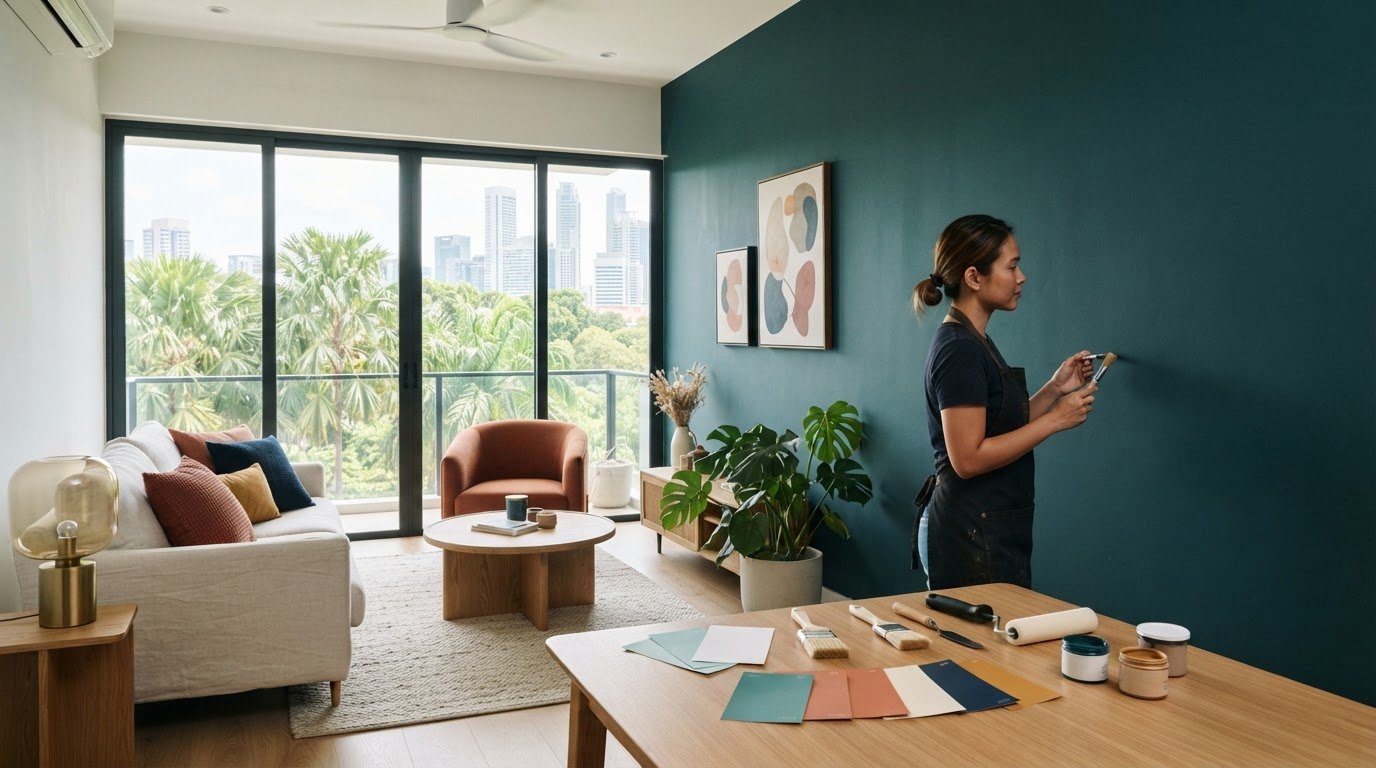
The accent colour you love on a sample card may not work in your room. The best accent wall color combinations start with the light, furnishings and finishes already in place, not just a trend. A rich blue or terracotta can add character, but the wrong pairing may feel overpowering or disconnected from the rest of the space.
A balanced palette gives the wall a clear purpose while helping the whole room feel considered. To narrow down your options, look at the room’s lighting, how you use the space, and the furniture and finishes you already own. You can also bring a favourite shade into a coordinated scheme without letting it dominate. Once you’ve chosen your palette, My Paint Job Singapore can help bring it to life with professional painting and low-odour, zero-VOC paint options.
Key Takeaways
- Use contrast to make an accent wall a strong focal point, or choose related shades for a softer effect.
- Explore accent wall color combinations that suit the mood you want, from calm and natural to warm or dramatic.
- Check fixed finishes and daylight, then compare paint samples with each other before choosing your palette.
- Surface preparation matters for a polished finish. My Paint Job follows Inspection → Preparation → Painting → Cleanup, with low-odour, zero-VOC paint options available.
How Accent Wall Color Combinations Create a Room’s Focal Point
An accent wall palette is the relationship between the feature-wall color and the colors around it, including other walls, furnishings and finishes. The wall becomes a focal point when its color stands apart from its surroundings. Strong contrast draws the eye quickly, while a feature shade close to the room’s existing tones creates a quieter point of interest.
A purposeful accent wall uses a distinct feature color that connects with the room’s surrounding colors. This keeps accent wall color combinations from feeling like isolated paint choices. The principles of color theory can help explain why certain shades contrast or harmonise, but the room itself should guide the final decision.
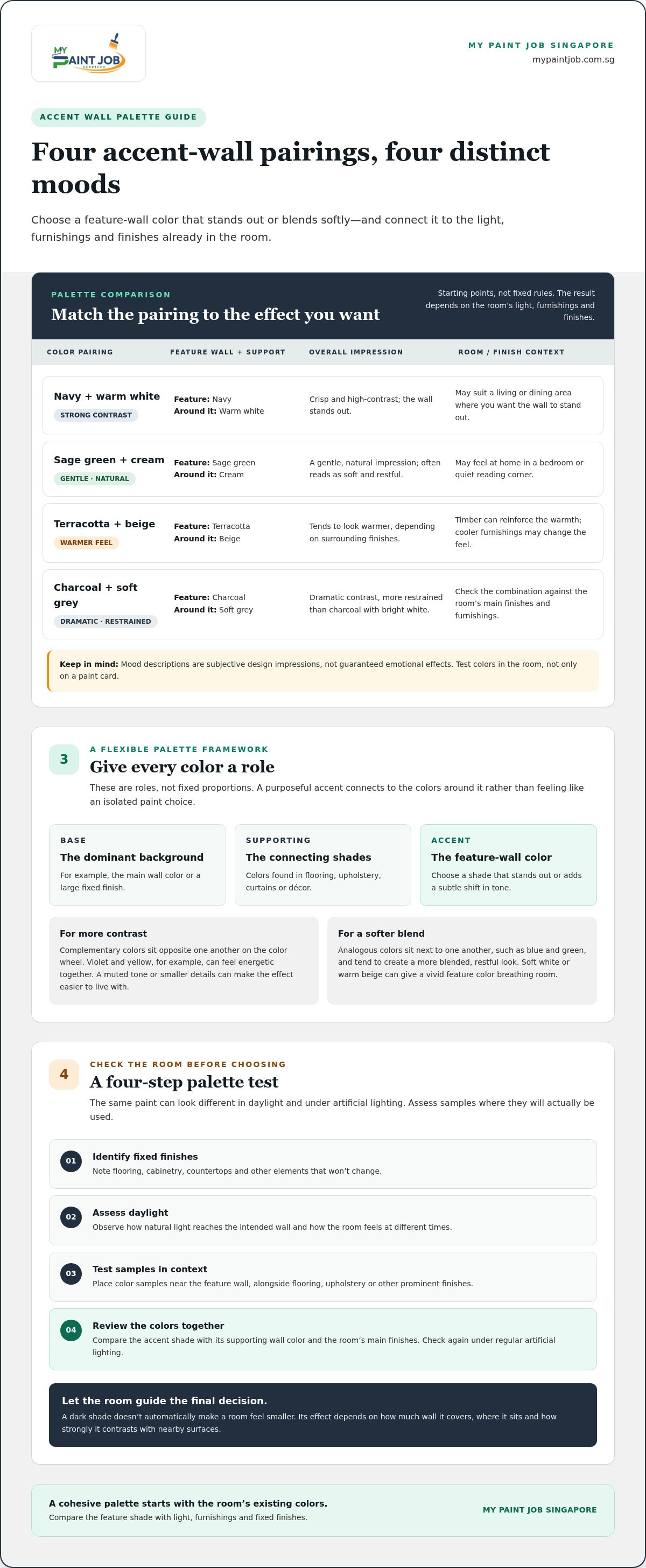
Use a flexible base, supporting and accent framework. These are roles, not fixed proportions:
- Base: The dominant background, such as the main wall color or a large fixed finish.
- Supporting: Secondary shades found in flooring, upholstery, curtains or décor that help the palette feel connected.
- Accent: The feature-wall color, chosen to stand out or add a subtle shift in tone.
What makes two or three accent wall colors work together?
Complementary colors sit opposite one another on the color wheel, so they create contrast. Violet and yellow, for example, can feel energetic together. Using one in a muted tone or in smaller details can make the effect easier to live with. Analogous colors sit next to one another on the wheel, such as blue and green, and tend to create a more blended, restful look. A neutral supporting shade, like soft white or warm beige, can give a vivid feature color breathing room without competing for attention.
Test the relationship in context, not just on a paint card. A combination may look appealing by itself but clash with timber tones, upholstery or the room’s overall mood. Choose the focal point first, then select supporting colors that make the whole space feel intentional.
Accent Wall Color Combinations to Try for Different Moods
Use these pairings as starting points, not fixed rules. Their effect depends on the room’s light, furnishings and finishes. Before choosing which shade takes the feature wall, decide whether you want a quiet blend or a stronger contrast.
- Navy with warm white: Put navy on the accent wall for a crisp, high-contrast look. It can suit a living or dining area where you want the wall to stand out.
- Sage green with cream: Use sage on the feature wall and cream around it for a gentle, natural impression. This pairing may feel at home in a bedroom or a quiet reading corner.
- Terracotta with beige: Make terracotta the accent and use beige as the supporting shade for a warmer-looking palette. Timber finishes can reinforce that impression, while cooler furnishings may change its feel.
- Charcoal with soft grey: Place charcoal on the feature wall and soft grey elsewhere for a dramatic contrast that’s more restrained than pairing charcoal with a bright white.
Which palettes feel calm, warm, or dramatic?
Sage and cream often read as soft and restful, while terracotta and beige tend to look warmer, depending on surrounding finishes. Navy with warm white and charcoal with soft grey create stronger contrast. These are subjective design impressions, not guaranteed emotional effects. For more on color psychology in interior design, consider how color choices can shape the way a space looks and feels.
How can existing furnishings guide your accent colors?
Start with a color already present in artwork, cushions, curtains or a rug, then adapt it for the accent wall. Check wood tones, flooring and large furniture too. For example, a warm-toned floor may sit more naturally beside beige or cream than a cool grey. Let the surrounding finishes guide your supporting wall color so the feature feels connected to the room, rather than added as an isolated statement.
Once your palette feels cohesive, My Paint Job’s professional accent wall painting can help bring it to life with a polished finish. Low-odour, zero-VOC paint options are available.
How to Choose an Accent Wall Palette for Your Room’s Light and Scale
Before settling on accent wall color combinations, check how your room’s finishes, light and proportions shape the colors you see. The same paint can look different in daylight and under artificial lighting, so judge the palette where it will actually be used. A dark shade doesn’t automatically make a room feel smaller. The effect depends on how much wall it covers, where it sits and how strongly it contrasts with nearby surfaces.
Assess paint samples in your actual room lighting, beside the finishes and supporting color they’ll need to work with. Use this four-step check:
- Identify fixed finishes. Note flooring, cabinetry, countertops and other elements that won’t change.
- Assess daylight. Observe how natural light reaches the intended wall and how the room feels at different times.
- Test samples. Place color samples near the feature wall rather than judging them in isolation.
- Review colors together. Compare the accent shade with its supporting wall color and the room’s main finishes.
How should you test an accent wall combination before painting?
Keep samples close to the wall you plan to paint, alongside flooring, upholstery or other prominent finishes. Look at them at different times of day, then switch on the room’s regular artificial lighting and compare again. Finally, view the accent and supporting colors together. This reveals whether they still feel coordinated as the light changes, before you commit to the full palette.
What should you consider in a compact or open-plan room?
In a compact room, consider how much of the visible space the accent color will occupy. A dark shade on one carefully chosen wall may create definition without making every surface feel heavy. Strong contrast across several large areas can have a different effect. In an open-plan layout, related tones can help connect zones while preserving a distinct focal point in each area.
For broader planning, explore this house painting services guide. My Paint Job provides professional painting to help bring your palette to life, with low-odour, zero-VOC paint options available.
Bring Your Accent Wall Color Combination to Life with Professional Painting
A well-chosen palette needs careful execution to look its best. Surface condition matters: uneven areas or existing imperfections can affect how consistently the color appears across the wall. An inspection helps identify what the surface needs before painting begins, while thorough preparation supports a cleaner, more polished finish.
What happens when a professional team paints your accent wall?
My Paint Job has more than 10 years of industry experience and provides professional accent wall painting. Its skilled painter team tailors the work to the project, following the process Inspection → Preparation → Painting → Cleanup. The team inspects the wall, prepares the surface, applies the chosen color, then completes cleanup. Surface protection with drop sheets and plastic covers, furniture movement and clean-up, and low-odour, zero-VOC paint options are available. My Paint Job also offers a 100% Satisfaction Guarantee.
Before painting, share how your accent wall color combinations relate to the surrounding walls and finishes. This helps the team understand the look you’re aiming for and tailor the painting project accordingly. A carefully prepared surface and considered application help bring that palette to life.
Where can an accent wall fit into a Singapore home painting project?
An accent wall can stand alone as a feature or form part of a wider home refresh. For HDB homeowners considering a broader project, the HDB painting services guide offers relevant planning context. In any home, consider how the feature wall will connect with nearby rooms, furnishings and existing finishes so the new color feels intentional within the whole home.
Ready to turn your palette into a finished wall? Request a free, non-obligatory quote for a tailored painting project.
Make Your Next Color Choice Feel Like Home
A fresh wall color can do more than change a room’s appearance. It can give a treasured piece of art a natural place to shine, make a familiar corner feel renewed, or bring a shared space closer to the atmosphere you want at home. Let your preferences lead, and give yourself room to choose a palette that feels right in the space, not just on a screen.
Once you’ve settled on your accent wall color combinations, the next step is turning that idea into a finished feature. My Paint Job brings more than 10 years of painting industry experience, offers a 100% Satisfaction Guarantee, and has low-odour, zero-VOC paint options available. Professional painting can help carry your chosen look through to the finished wall.
Ready to take the next step? Request a free, non-obligatory painting quote and start planning a space that feels unmistakably yours.
Frequently Asked Questions
Can an accent wall have more than one color?
Yes, an accent wall can use multiple shades in a color block or two-tone design. For example, a muted lower section and a lighter upper section can create a visual division without adding another furnishing or partition. Keep the shades connected to the room’s existing palette. Before painting, view the samples together on the intended wall so you can judge the overall effect, not just each color individually.
Should an accent wall be lighter or darker than the other walls?
Either approach can work, depending on the effect you want. A dark wall behind a light sofa can make the seating area stand out, while a lighter feature wall can add definition against deeper surrounding colors. Consider what you want people to notice first, such as a bed, dining table or artwork. Check the proposed contrast against those focal elements before settling on the shade.
How many colors should an accent wall combination include?
There’s no fixed number, but a clear palette is often easier to coordinate than one with many competing shades. Start with the feature-wall color and the surrounding wall color, then consider the colors already present in larger elements such as flooring or a sofa. Artwork and cushions can introduce smaller accents. Give every color a role so the room feels deliberate rather than visually busy.
Can an accent wall work in a small room?
Yes, a small room can have an accent wall. Think about the wall’s position and how much of it is visible from the doorway or main seating area. A saturated color may draw attention to that surface, while a more muted shade can create a gentler distinction. Look at samples beside the room’s furniture and finishes, and consider how the wall appears from different viewpoints.
How do I choose an accent wall color for an open-plan room?
Choose a shade that relates to colors already repeated across the connected spaces, such as flooring, upholstery or curtains. For instance, a supporting tone from the living area’s rug could appear again in dining-area accessories, helping the zones feel connected. Then use the accent wall to give one area its own visual focus. Review the palette from several positions, including the transitions between spaces.