
Did you know that in 2025 alone, the HDB received 240 complaints about mold and condensation caused simply by how neighbors used their air-conditioners? When you’re dealing with removing mold from walls in Singapore’s relentless humidity, a quick scrub is often just a temporary “reset” for the next bloom. It’s exhausting to see your beautiful paintwork peel or to worry about your children breathing in musty air, especially when standard cleaning products don’t seem to provide a lasting fix.
We understand that you want a home that reflects your pride in ownership without the constant stress of underlying dampness. This 2026 guide moves beyond surface-level wiping to offer permanent, professional-grade solutions tailored for our local climate. You’ll learn how to identify the true source of moisture, neutralize spores effectively, and restore your walls so they stay pristine. We will preview the essential steps to transform your living environment from a damp struggle into a healthy, renewed space through technical accuracy and proven craftsmanship.
Key Takeaways
- Understand how Singapore’s 80% relative humidity and air-conditioning temperature gaps create the perfect environment for hidden fungal growth on your masonry.
- Master essential safety protocols and learn why choosing vinegar over bleach is the key to actually killing mold roots during the process of removing mold from walls.
- Discover the professional two-step restoration method involving fungicidal washes and specialized plastering to ensure all contaminated material is fully neutralized.
- Implement the “15-Minute Rule” for cross-ventilation and learn how to select high-performance anti-mold paints that offer genuine environmental resistance.
Why is mold growing on your walls in Singapore?
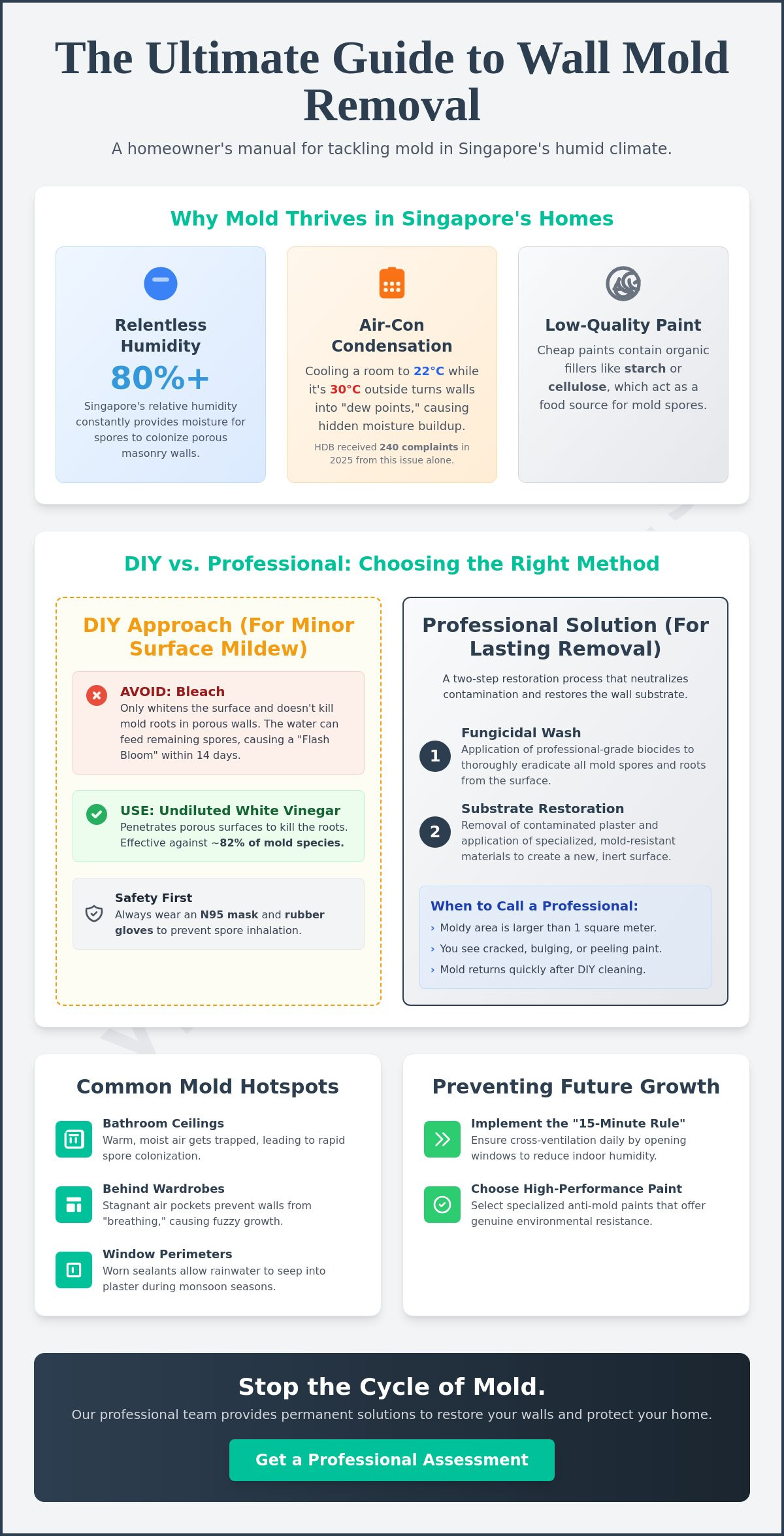
Singapore’s tropical climate provides a relentless breeding ground for fungi. With relative humidity levels frequently exceeding 80%, moisture penetrates porous masonry surfaces and creates a damp foundation where spores thrive. Removing mold from walls effectively requires you to understand that this isn’t just a surface stain; it’s a structural environmental reaction. For a comprehensive overview of indoor mold and its biological triggers, scientific research confirms that consistent moisture is the single most critical factor for colonization.
Many homeowners don’t realize that their air-conditioning habits actually contribute to the problem. When you chill a bedroom to 22°C while the external environment or adjacent room remains at 30°C, the wall becomes a “dew point” surface. This temperature differential causes hidden condensation to form inside the wall structure or behind heavy furniture. This moisture then feeds on the organic matter found in lower-quality paints. Fillers like starch or cellulose in cheap tins act as a buffet for mold spores, allowing them to anchor deep into the substrate.
Identify the type of growth before you attempt any cleaning. Surface mildew often looks like a light dusting of grey or white powder and is relatively easy to wipe away. However, deep-rooted black mold, or Stachybotrys, appears as slimy, dark green or black patches. This variety penetrates the paint layer and poses the greatest risk to respiratory health for children and the elderly. If you see dark clusters that reappear weeks after cleaning, the infestation has likely moved beyond the surface and into the plaster itself.
Common HDB and Condo mold hotspots
Bathroom ceilings: Warm, moist air rises and gets trapped against cold concrete slabs. Without a high-quality exhaust fan or consistent window ventilation, these areas see rapid spore colonization that eventually spreads to the rest of the unit.
Behind wardrobes: Stagnant air pockets form when large furniture is pushed flush against external walls. This lack of airflow prevents the wall from “breathing,” leading to fuzzy growth that often goes unnoticed until you detect a persistent musty smell in the bedroom.
Window perimeters: Worn out sealants allow rainwater to seep into the surrounding plaster during monsoon seasons. This localized dampness is a primary culprit for peeling paint and recurring mold clusters near window frames. Address these leaks first to ensure removing mold from walls becomes a permanent fix rather than a monthly chore.
How to remove mold from walls: DIY vs. Professional methods
Many homeowners reach for bleach as a first resort, but this often does more harm than good. Bleach is an oxidizer that whitens the surface without killing the roots, especially on porous masonry. Instead, use undiluted white vinegar. Research indicates it’s effective against roughly 82% of mold species and penetrates deeper to neutralize the source. When you begin removing mold from walls, always prioritize your health. Follow the basic mold cleanup steps by wearing N95 masks and rubber gloves to prevent spore inhalation.
Avoid the urge to scrub aggressively. High-friction scrubbing can actually push microscopic spores further into the plaster, leading to a deeper infestation. Use the “Wipe-and-Wait” test to diagnose the severity: clean a small patch and monitor it for 72 hours. If the dark shadow returns immediately, the mold has likely penetrated the paint film and settled into the wall substrate. Removing mold from walls is a technical task that requires the right chemistry, not just physical effort.
The limitations of DIY mold cleaning
Surface cleaning is often a temporary “reset” because it doesn’t address spores living inside porous concrete. You might experience a “Flash Bloom,” where mold returns within 14 days of a bleach wash. This happens because the water in the bleach solution soaks into the wall, providing a fresh moisture source for any surviving roots. DIY methods work for minor mildew, but they rarely solve the environmental imbalance that causes recurring growth.
When to skip the sponge and call a professional
If you notice cracked, bulging surfaces or rusted metal bits, you may need spalling concrete repair singapore rather than a simple cleaning. This indicates structural moisture issues that sponges cannot fix. As a general rule, any moldy area larger than 1 square meter requires professional remediation to ensure safety and technical accuracy. For larger projects that demand a lasting finish, our team provides specialized painting services to restore your walls and your peace of mind.
Permanent removal: Restoring the wall substrate
Removing mold from walls permanently requires a shift in perspective. You aren’t just cleaning a stain; you’re treating a sick substrate. Start with a professional-grade fungicidal wash to neutralize any remaining dormant spores. This chemical step ensures that the biological roots are completely inert before you move to physical restoration. Once neutralized, you must scrape away all loose or flaking material. This often involves repairing plaster walls to remove contaminated layers that have lost their structural integrity and moisture resistance.
When you’re removing mold from walls at this level, you’re investing in the long-term health of your property. Following the physical removal, apply a high-performance paint sealer. Think of this as a defensive shield for your home. It creates a non-porous moisture barrier that prevents dampness from migrating through the masonry to your fresh paint. Finish the process with premium anti-mould paints specifically formulated for Singapore’s heat. These paints contain active biocides that provide a secondary layer of defense, which is a key part of preventing future mold growth in high-humidity environments.
Why high-quality sealers are essential
Standard primers are designed for adhesion, but they don’t block environmental threats. In Singapore, alkaline salts within the concrete can react with moisture to push through the paint film. An oil-based, anti-fungal sealer acts as a chemical block. It stops these salts and prevents moisture from reaching the surface, ensuring your aesthetic investment remains intact for years. This technical accuracy distinguishes a simple paint job from a professional restoration.
Restoring smooth surfaces with skim coating
Spores love the microscopic cracks and crevices found in uneven walls. These tiny valleys trap dust and moisture, creating a buffet for mold. Professional skim coating levels the surface to a glass-like finish. This non-porous surface leaves no place for spores to hide or anchor. If you’re ready to secure a mold-free environment, our HDB and condo painting services leverage our years of hands-on experience to restore your home with integrity and technical precision.
Preventing future mold: Maintenance and environmental tips
Successfully removing mold from walls is a significant first step, but environmental management is what ensures the fungus doesn’t return. We advocate for the ’15-Minute Rule’ in every Singaporean household. After showering or cooking, open your windows and doors to create a cross-ventilation path for exactly fifteen minutes. This simple habit exhausts the moisture-laden air before it can settle on your freshly restored surfaces and trigger a new growth cycle.
Proper use of technology also plays a vital role in moisture control. Position a dehumidifier in areas with limited airflow, such as walk-in wardrobes or corner units, and set it to maintain a relative humidity between 45% and 55%. This range inhibits spore germination without making the air uncomfortably dry. Conduct routine visual inspections every quarter. Look for faint, greyish streaks known as ‘ghosting,’ which serve as an early warning sign before deep-rooted mold establishes itself again.
When selecting your finish, don’t rely solely on marketing labels. Many ‘Anti-Mould’ products lose their efficacy within months in our tropical climate. High-performance coatings with active biocides provide a chemical defense that complements the physical barriers we’ve discussed. This final layer is essential for removing mold from walls in the long term, acting as a secondary shield against airborne spores that thrive in our local heat.
The My Paint Job Singapore approach to mold-free homes
Our team at My Paint Job Singapore treats every property with technical accuracy and a commitment to lasting results. We implement a rigorous 3-layer protection system that includes a total-neutralization fungicide, a high-performance moisture sealer, and a premium anti-mould topcoat. We prioritize your convenience by including full furniture protection and a comprehensive post-job cleanup as standard for every project, ensuring your home remains a clean and healthy sanctuary.
Ready to reclaim your walls? Get a professional mold assessment and painting quote today and experience the peace of mind that comes with expert craftsmanship and reliable service from My Paint Job Singapore.
Reclaim Your Healthy Home Environment
Achieving a mold-free home in Singapore’s humidity requires a move from temporary fixes to technical restoration. You’ve learned that removing mold from walls effectively depends on neutralizing the substrate and managing environmental moisture through tools like dehumidifiers and the 15-minute ventilation rule. A beautiful, healthy bedroom or living room is possible when you combine the right anti-fungal chemistry with consistent maintenance habits.
With over 10 years of experience in Singapore residential painting, we’ve developed specialized anti-fungal treatment protocols that go far beyond surface cleaning. We take the stress out of the process by providing a hassle-free service that includes full furniture protection and meticulous cleanup. Your property is in safe, capable hands with our team of dedicated specialists who value integrity and craftsmanship. Get a Free Quote for Professional Mold Treatment & Painting and start your journey toward a renewed, vibrant living space today. You deserve an environment that feels as fresh as it looks.
Frequently Asked Questions
Is it safe to sleep in a room with mold on the walls?
It isn’t advisable to sleep in a room with visible growth because of the continuous exposure to airborne spores. These microscopic particles can irritate your respiratory system, potentially leading to sleep disruption, persistent coughing, or worsened asthma symptoms for children and the elderly. If you detect a strong musty odor, the spore concentration is likely high enough to affect your air quality significantly. Address the issue immediately to restore a healthy sleeping environment and protect your family’s well-being.
Can I just paint over mold with anti-mould paint?
You shouldn’t paint directly over active mold because the fungus will continue to grow beneath the new layer and eventually cause the paint to bubble or peel. Anti-mould paint is designed as a preventative measure, not a curative one. If the underlying spores aren’t neutralized first, they’ll simply feed on the organic matter in the wall substrate. Always follow a strict protocol of cleaning and sealing before applying any decorative topcoat to ensure your aesthetic investment lasts for years.
What is the best solution for removing mold from walls permanently?
The most effective solution for removing mold from walls involves a three-stage approach of neutralization, substrate restoration, and humidity control. First, use a professional-grade fungicidal wash to kill the roots. Second, repair any damaged plaster and apply a high-quality moisture-blocking sealer to create a defensive barrier. Finally, maintain indoor humidity levels below 60% to prevent the environment from becoming hospitable to new spores. This technical precision ensures the mold doesn’t return after the job is finished.
Does air conditioning prevent or cause mold on walls?
Air conditioning acts as a double-edged sword in Singapore’s tropical climate. While the cooling process naturally dehumidifies the air, it also creates cold wall surfaces that lead to condensation when they meet warmer air from adjacent rooms. This “dew point” effect is a common cause of hidden growth behind wardrobes or on shared walls. Use your air-con in ‘Dry Mode’ when possible and ensure your rooms are properly ventilated daily to balance temperature and moisture levels effectively.
How much does professional mold removal and repainting cost in Singapore?
The total investment for professional remediation depends heavily on the severity of the infestation and the total square footage of the affected area. Mild cases localized to a single wall typically require less labor than a full-unit treatment involving structural plaster repairs. While industry rates for specialized remediation vary, the true value lies in the long-term protection and hygiene of your property. Request a detailed onsite assessment to receive an accurate quote tailored to your home’s specific structural needs.

Pingback: Best Paint for Humid Rooms: What Works - My Paint Job Singapore